
✈ Flying to Tibet
Allow document checks at check-in and boarding; names, documents and itinerary must match. Leave time for original delivery and check Chinese entry eligibility for your connection separately.
Discover history, experience culture, understand faith and meet the people who call Tibet home.
At Snowland Travel, we value the perspectives of people living in Tibet. We introduce you to its rich history, enduring culture and faith, and the rhythms of everyday life.
We help prepare required documents, plan the approved route and coordinate original-document delivery and local arrangements. Confirm traveller status and the itinerary before committing to transport and other bookings.
Our travel-preparation requirement is to carry the original Tibet approval and the original valid document used for booking for both flights and trains into Tibet. Do not rely only on phone images, scans or photocopies. If the original has not reached you, contact us before heading to the airport or station.
Allow document checks at check-in and boarding; names, documents and itinerary must match. Leave time for original delivery and check Chinese entry eligibility for your connection separately.
Carry originals for station entry, boarding and en-route checks. Reconfirm the actual station, service and carrier requirements before departure rather than relying on a past journey where a copy was accepted.
This is our preparation policy; actual checks follow the latest issuing-authority and carrier instructions.
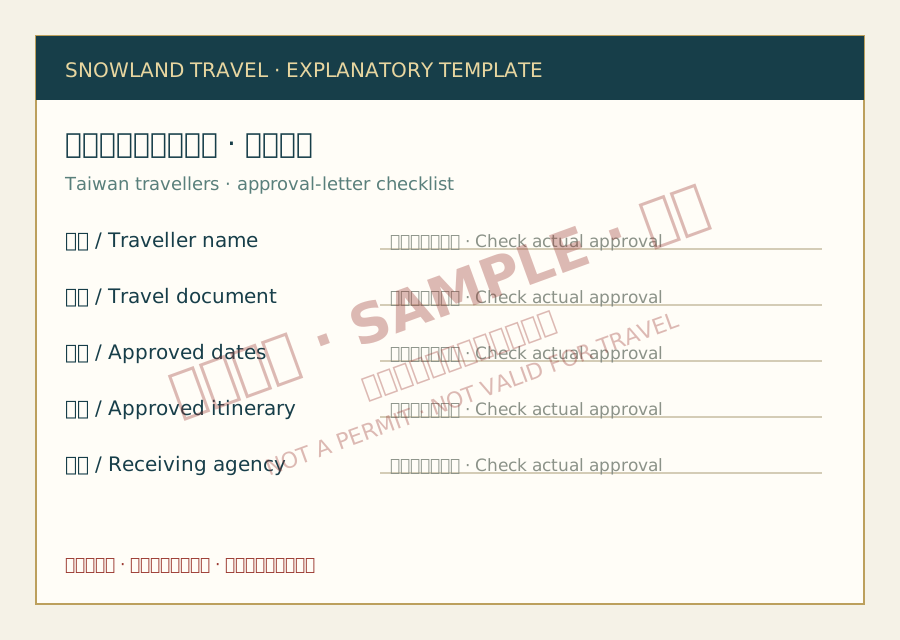
These agency-made diagrams are information checklists, not photographs of issued permits. They contain no official seals, document numbers or personal identities. They explain what to check and cannot be used for Tibet entry, rail boarding or flights.
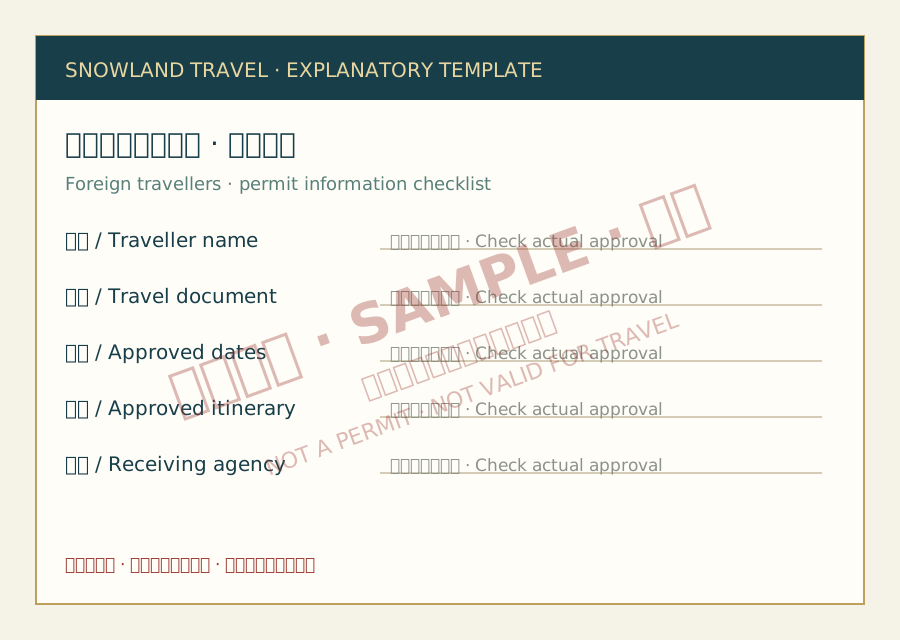
Prepare the valid passport information page and details of your applicable Chinese visa, visa exemption or residence status, plus dates, route, entry/exit transport and original-delivery address. Visa-free entry to China does not remove Tibet approval requirements.
Provide clear details of your valid Mainland Travel Permit for Taiwan Residents (台胞证) and any additional documents requested for the application. The travel permit is not the Tibet approval letter; a Taiwan resident residence card does not replace the required travel document or Tibet formalities.
You need not submit identity-document photographs in the initial public enquiry. Agree the document list and a secure sending method first; the public website form is not for uploading passports or Taiwan travel documents.
Foreign and Taiwan travellers must follow agency-organised, approved arrangements in the Tibet Autonomous Region. Independent unpermitted travel is not offered; private groups can be discussed.
Ask about a private tour or joining a group. Solo participation still requires applicable approvals; guide, vehicle and group conditions are confirmed separately.
No. Chinese entry eligibility and Tibet tourism approvals are checked separately for your documents and route.
The mainland travel document is not the Tibet approval. Arrange the applicable approval through the agency and confirm original delivery with the organised itinerary.
Our application-planning requirement is to submit complete documents at least 20 working days before a standard Tibet trip, or at least one month before a Ngari/Kailash journey. Where both apply, allow the more generous preparation period, plus time for holidays, additional documents and route changes. These are preparation deadlines, not guaranteed issue dates; the authority decides approval.
Under our preparation policy, carry the original Tibet approval and booking ID for both modes. Recheck actual boarding rules before travel rather than relying on a phone image or previous copy acceptance.
Agree a suitable mainland hotel or handover point, checking the stay, recipient and phone. Avoid tight same-day connections before delivery is confirmed.
No. Authorities decide issuance and access; document or regional changes may affect the application. Understand ticket/hotel change terms before committing.
No. Everest, Ngari, border and non-open areas have different conditions. Stay within approved routing and do not enter closed religious, protected or military areas.
Discuss any change affecting approvals or arrangements with the agency first; do not drive independently into unapproved areas.
They are outside the Tibet Autonomous Region, so its approval process does not simply apply. Check individual monastery, border and local access conditions separately.
No. Requirements depend on actual nationality, documents and region, not ethnicity; border-route requirements still need separate checks.
Discuss health before travel and rest after arrival. Do not ascend while unwell; worsening symptoms, breathing difficulty, confusion or walking problems require urgent medical and guide assistance.
No. Use plateau-carriage oxygen only as staff direct. The railway still reaches very high altitudes; report illness promptly.
Review health, route and sleeping altitude rather than assuming suitability by age. Discuss medical or special needs with a clinician and our team.
Discuss four-star-class city stays, with simpler remote facilities possible. Train and trek accommodation are not hotel-star products; specify standards before booking.
Tell us early so we can check restaurants and simple meals by location. Remote choices are limited; strict allergen segregation is not guaranteed.
Bring layers, wind/rain protection, sun protection, a hat and comfortable grippy shoes; request route-specific packing advice for season, passes and stays.
Some overseas services are restricted on ordinary mainland networks. Check lawful connectivity or VPN options with your provider; access is not guaranteed. Keep phone contacts and documents offline.
Follow site rules: interiors may prohibit photography or charge fees. Ask people first, respect worship and do not photograph checkpoints or security facilities without permission.
The designated Everest visitor area is distinct from mountaineering camps, and Kailash viewing differs from a kora trek. Review access, walking, altitude, stays and support; all camps are not assumed accessible.
Routes can be discussed without implying current availability. Check the crossing, nationality/documents, approved road, weather and access before any overland departure is confirmed.
Agree the written itinerary, quote and inclusions before paying under the contract. Flights, trains, hotels and permit handling can have different change terms; review them before payment rather than assuming universal free cancellation.
Check coverage for Tibet, planned altitude, walking and medical evacuation, plus pre-existing conditions and cancellation; ordinary policies may not cover everything.
Tell the guide and agency promptly and review changes, rest or withdrawal rather than forcing visits. Discuss extra transport/stays and refunds under actual circumstances and the contract.
Start once you have approximate dates. Discuss ordinary routes one to two months ahead and Everest, Ngari, blossom-season or holiday travel two to three months ahead. Complete documents must still meet our 20-working-day or Ngari one-month preparation requirement. Rooms, tickets and prices depend on confirmation.
Winter cultural journeys around Lhasa and Shigatse can be discussed. Review day/night temperature differences, heating, icy roads and site openings; snow can delay or alter high-pass, lake and Ngari routes. Lower prices are date-dependent, not guaranteed.
Choose for your destinations and interests: spring for possible Nyingchi blossoms, warmer summer with rain considerations, autumn mountain/culture routes, or selected winter city visits. Do not infer altitude suitability for children or older travellers simply from summer conditions. Flowering, visibility and festival dates need annual checks.
Begin with a Lhasa base, reserved Potala/Jokhang visits, Barkhor and rest. Then consider Yamdrok, Tsang, Everest or Namtso for your time and acclimatisation. Avoid compressing every high-altitude highlight into a short trip; we prioritise interests and actual access.
Allow acclimatisation and daily review before the high Everest visitor area. Bring warm layers and confirm heating, bathrooms and hot water; tents are not assumed warm. Driving, local shuttles and stays depend on roads and health. Sunrise, sunset and stars are weather-dependent; visitor viewpoints are not mountaineering base camps.
Transfers can be arranged; inclusion follows the written quote. Share exact flight/train details, dates and party size, then confirm service hours, waiting, meeting point and delay contacts. Free transfers at any time are not assumed.
Protect documents and valuables, follow checks, road and religious-site rules, avoid isolated areas without support and keep off unsafe road edges and ice. Follow agreed guide/vehicle arrangements and report illness. No destination or itinerary is risk-free.
Do not open plateau-train windows without permission. Reflections, cleanliness and passage times affect photography; not every landscape is seen in daylight. Sockets vary and a private, continuously working outlet per berth is not guaranteed. Bring a carrier-compliant power bank and save documents offline.
Do not infer these facilities from star class. Confirm heating type/season/hours, hot water, oxygen availability and any charges for each property. Remote power and water may be unreliable; oxygen is not a substitute for health assessment or care.
Carrying a drone does not authorise flying it. Check registration and equipment/battery transport rules, then airspace, site and local restrictions; controlled airspace requires approval. Do not launch independently near monasteries, borders, airports or security-sensitive locations. We do not guarantee flight permission.
Any contractual gratuity arrangement is explained before booking. Where it is not an agreed mandatory charge, tipping is voluntary and can reflect your appreciation. Other operators’ suggested amounts are not a universal standard.
SNOWLAND TRAVEL